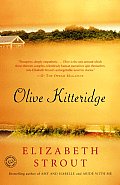
 Sometimes I think my mind must be turning to mush. I am thoroughly engaged in vampire stories and formulaic legal thrillers, but then I pick up something ostensibly of true literary value - a Pulitzer winner no less - and I just find it incredibly tedious. I'm trying to tell myself that it's the difference between a good story and good writing. Certainly, I can acknowledge that Olive Kitteridge, a collection of 13 stories about a retired schoolteacher in small-town Maine, is certainly well-written, but I just found it boring. The title character, Olive, is thoroughly unlikeable. Everything about her is negative - and while everyone around her (particularly her son) seems hell-bent on getting as far from her as possible (except her saintly husband who stays in love with her for reasons unfathomable), Olive just seems to live in her own world where nothing but her own opinions and needs matter. While not every story has Olive as the focus - sometimes she just appears as a passing character - I just couldn't find anything about the world Strout created that I wanted to keep reading about. Usually, I feel this way about the Man Booker prize winners, but alas the Pulitzer has become too intellectual for me. I'll keep looking to their winners for book suggestions, but as I get older and more feeble-minded, I may be sticking to the New York Times bestsellers.
Showing posts with label Pulitzer Winner. Show all posts
Showing posts with label Pulitzer Winner. Show all posts
Saturday, July 10, 2010
Olive Kitteridge - Elizabeth Strout
Sometimes I think my mind must be turning to mush. I am thoroughly engaged in vampire stories and formulaic legal thrillers, but then I pick up something ostensibly of true literary value - a Pulitzer winner no less - and I just find it incredibly tedious. I'm trying to tell myself that it's the difference between a good story and good writing. Certainly, I can acknowledge that Olive Kitteridge, a collection of 13 stories about a retired schoolteacher in small-town Maine, is certainly well-written, but I just found it boring. The title character, Olive, is thoroughly unlikeable. Everything about her is negative - and while everyone around her (particularly her son) seems hell-bent on getting as far from her as possible (except her saintly husband who stays in love with her for reasons unfathomable), Olive just seems to live in her own world where nothing but her own opinions and needs matter. While not every story has Olive as the focus - sometimes she just appears as a passing character - I just couldn't find anything about the world Strout created that I wanted to keep reading about. Usually, I feel this way about the Man Booker prize winners, but alas the Pulitzer has become too intellectual for me. I'll keep looking to their winners for book suggestions, but as I get older and more feeble-minded, I may be sticking to the New York Times bestsellers.
Friday, October 26, 2007
A Death in the Family* - James Agee
 My goal this month was to read books by authors that start with the letter "A." I haven't done that well - but this one also satisfied my desire to read more winners of the Pulitzer Prize. A Death in the Family was published after Agee's death - when it was not quite in final form. Sections of the manuscript didn't seem to make sense, and so portions are published in italics - indicating where folks believed Agee would have placed the material in a final draft. Apparently, Agee was also a notorious re-writer, so it's possible half of this would have ended up on the cutting room floor. Whatever the case, it is an interesting well-written book, but quite slow - it reminded me quite a bit of A Summons to Memphis. The basic premise is that a man is called home to visit his dying father. Only, it turns out his father is fine, and on the drive back home to see his family, the man is in a fatal car accident. The remainder of the book focuses on his widow, their two children, and the widow's family who try to help her cope with her loss. There is significant dialogue in the novel, but also something about the descriptions made me think that this would be better presented as a play. After thinking this, I looked Agee up on www.wikipedia.org and leared that he was in fact a screenwriter. He suffered from alcoholism, and died at the age of 45 following two heart attacks.
(* - Winner of the 1958 Pulitzer Prize - awarded post-humously)
Monday, September 24, 2007
A Summons to Memphis* - Peter Taylor
 In general, I am a big fan of Southern Literature. I'm not quite sure why - since I've never really been to the south, and don't have any connection to it. But, I think the history of the South lends itself to stories about families and secrets and the struggle between doing what's right/for yourself and doing what is expected of you by others - all themes which I find quite interesting. A Summons To Memphis is told from the perspective of Philip, the younger brother of two meddling sisters. The book opens with their plea for his to return home from New York to help prevent their aging widower father from remarrying and giving away their inheritance. As Philip returns home, he recounts how his family made its way to Memphis from Nashville, and the unlucky relationships that he and both his sisters have endured. Taylor's story and his writing reminded me of Henry James. Not a lot happened in this book in terms of plot, but I found myself absolutely enthralled by the language. Taylor's characters, like those of James, often say and do things while meaning quite the opposite. While it can be frustrating to understand the subtext, it is a fascinating study in manipulation. I have a love/hate relationship with the winners of the Pulitzer, but this is one the committee definitely got right.
(* - Winner of the 1987 Pulitzer Prize)
Thursday, July 26, 2007
The Road* - Cormac McCarthy
 http://www.cormacmccarthy.com/ - A unnamed man and his young son move south toward the coast, attempting to evade starvation and possible capture, in a post-apocalyptic world. While the father repeatedly reassures his frightened child that they are the "good guys," every encounter with another human being reveals the desperation and inhumanity necessary for their survival. The little boy is infinitely sweet, pleading with his father to help the others, and haunted by another little boy he sees and is forced to abandon along the way. Recently, I feel like I've read so many books that deal with human nature in trying times - and how horrible situations can make good people do horrible things. This was a very difficult book for me to read - I felt as if the little boy's fear absolutely invaded me. I did not appreciate the writing style of this book as much as All The Pretty Horses. The Road is told in an almost piece-meal simplistic style - not as a full narrative - almost like the thoughts of someone starving and on the brink of death. The images are haunting, and I wonder if the world we lived in came to this, would I really want to keep living? Sometimes I measure the greatness or value of a book or movie by how much it stays with me, or how much I keep thinking about it after I'm done reading or watching. By that yardstick, The Road is a definite classic.
(* - Winner of the 2007 Pulitzer Prize for Literature)
Thursday, December 28, 2006
Gilead* - Marilynne Robinson (Halfway)
http://www.powells.com/biblio/2-031242440x-5 - Earlier this year I made a rule: If I wasn't in to a book after 100 pages, I'd just set it to the side and give up. There are too many books to read to slog through ones I'm not enjoying. After 80 pages of Gilead, I wanted to just lie down and die. While very well written, this is an incredibly slow moving book - a letter from a dying preacher to his seven year old son. The narrative walks through the lives, not only of the preacher himself, but of his grandfather and father. It reminded me of a slower moving Cold Mountain, but not as interesting. The book is only about 200 pages, so I thought I'd give it more of a chance. After 120, I was done. I will not be finishing this one.
(* - Winner of the 2005 Pulitzer)
(* - Winner of the 2005 Pulitzer)
Subscribe to:
Posts (Atom)