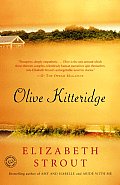
 Sometimes I think my mind must be turning to mush. I am thoroughly engaged in vampire stories and formulaic legal thrillers, but then I pick up something ostensibly of true literary value - a Pulitzer winner no less - and I just find it incredibly tedious. I'm trying to tell myself that it's the difference between a good story and good writing. Certainly, I can acknowledge that Olive Kitteridge, a collection of 13 stories about a retired schoolteacher in small-town Maine, is certainly well-written, but I just found it boring. The title character, Olive, is thoroughly unlikeable. Everything about her is negative - and while everyone around her (particularly her son) seems hell-bent on getting as far from her as possible (except her saintly husband who stays in love with her for reasons unfathomable), Olive just seems to live in her own world where nothing but her own opinions and needs matter. While not every story has Olive as the focus - sometimes she just appears as a passing character - I just couldn't find anything about the world Strout created that I wanted to keep reading about. Usually, I feel this way about the Man Booker prize winners, but alas the Pulitzer has become too intellectual for me. I'll keep looking to their winners for book suggestions, but as I get older and more feeble-minded, I may be sticking to the New York Times bestsellers.
Saturday, July 10, 2010
Olive Kitteridge - Elizabeth Strout
Sometimes I think my mind must be turning to mush. I am thoroughly engaged in vampire stories and formulaic legal thrillers, but then I pick up something ostensibly of true literary value - a Pulitzer winner no less - and I just find it incredibly tedious. I'm trying to tell myself that it's the difference between a good story and good writing. Certainly, I can acknowledge that Olive Kitteridge, a collection of 13 stories about a retired schoolteacher in small-town Maine, is certainly well-written, but I just found it boring. The title character, Olive, is thoroughly unlikeable. Everything about her is negative - and while everyone around her (particularly her son) seems hell-bent on getting as far from her as possible (except her saintly husband who stays in love with her for reasons unfathomable), Olive just seems to live in her own world where nothing but her own opinions and needs matter. While not every story has Olive as the focus - sometimes she just appears as a passing character - I just couldn't find anything about the world Strout created that I wanted to keep reading about. Usually, I feel this way about the Man Booker prize winners, but alas the Pulitzer has become too intellectual for me. I'll keep looking to their winners for book suggestions, but as I get older and more feeble-minded, I may be sticking to the New York Times bestsellers.
Tuesday, July 6, 2010
Dead as a Doornail & Definitely Dead - Charlaine Harris (Sookie Stackhouse Series #5 and #6)
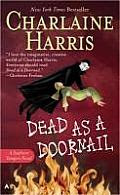
 With the third season of True Blood now underway, I figured I better get back on the Sookie Stackhouse series before the television show catches up with me - it's clear to me that my enjoyment of the books significantly increased once I got past the point of the television show. It could also be that Harris's writing improved a tad bit as the series went on, but to be honest, not that much, it's still pretty bad. But, the story is good. So good that once I finished #5, I moved right on to #6, and am sad that I don't have #7 right at my fingertips (hopefully, my local library will set me up soon enough!). Dead as a Doornail focuses more on the local were community - when three shifters are shot by an unknown assailant, Sookie takes it upon herself to figure out the mystery, bringing her closer to Alcide, and intimately involved in the were struggle for power. In Definitely Dead, Sookie finds herself a romantic interest (yay, I was getting so tired of the Bill/Eric dynamic), and travels to New Orleans to clean up after her vampire-cousin is killed. This series is good mindless fun and I'm glad I stuck with it after the first few. Harris is definitely on a roll, and I can't wait to get my hands on the next one.
Storm Front - Jim Butcher (Dresden Files Series #1)
 This book definitely requires some suspension of disbelief. And strangely for me, more so than other science-fiction/fantasy that I've read. Maybe because it sort-of takes place in the normal world, but is just filled with complete weirdness. I suppose it's no different than the True Blood vampire books I've been getting into lately, but for some reason, this one just did a number on my head. The main character, Harry Dresden is a wizard. He's also a private investigator who helps out the police department from time to time. There isn't really an explanation (that I can recall) as to how he became a wizard. It's unclear to me whether his parents were wizards and he was born into it - or whether he studied really hard and became a wizard (there's another charater in the book who studies and becomes one, so this is clearly possible - though Harry's participation in some secret societies suggest he's something more). When a couple is found brutally murdered, Harry is brought in to find the killer. It's clear that some on the police force believe in his supernatural powers - and buy his explanation that there are some vampires and other spritely creatures involved. And there are others on the force that think he is a complete hoax. And so Harry goes about trying to solve the crime just like any other private detective might - only along the way he has the help of a fairy who loves pizza, and a goblin of some sort that lives in a skull in his basement. At least to keep things familiar to the detective genre, the author made Harry totally awkward when it comes to women, and there is some disastrous dating that also goes on in the story. I'm a bit intrigued by the concept here, and I think I'll read at least one or two more in this series (of 13), but I'm just not sure how much I can buy into a wizard detective who solves crimes - it just seems too easy for him to conjure up a spell that seems a bit too much like cheating to figure it all out.
Stuff:Compulsive Hoarding and the Meaning of Things - Randy Frost & Gail Steketee
 Thanks to some strange reality shows on television these days, most people have heard of the concept of hoarders - individuals who seem simply to collect stuff - newspapers, magazines, junk - until it completely fills their lives, making them prisoners in their own homes. This book attempts to understand what compels people to become hoarders - and what meaning they attribute to objects that the rest of us might merely view as junk. The authors are mental health professionals with backgrounds in obsessive compulsive disorder- and they began their research with the assumption that hoarding was a form of OCD. Their research, however, leads them in a different direction - looking more to trauma and dysfunctional personal relationships as the cause for these seemingly strange attachments. The authors tell the story of hoarding through the examples of specific individuals, and I thought they did a marvelous job of truly humanizing this bizarre behavior. I think this book could easily have become freak-show voyeurism, but I found it really painful to see what these individuals were going through in terms of their anxiety and inability to part with these objects. I also found interesting the different types of hoarding - from the newspapers and junk we expect, to people who are collecting decaying garbage populated with rats and cockroaches, to people who hoard animals, to children with hoarding compulsions (these, to me, were the strangest of all). I really appreciated that throughout the book, the authors emphasized practical approaches for dealing with hoarders - involving them in the decisions to get rid of things, even when that process may take years and years, for example. And, at the end of the book, there is a really helpful section with resources, support groups, and other help for people who want to get help for themselves or their loved ones. Hoarding is a fascinating mental illness, and one that clearly requires more studying and understanding. This book is an easy read for someone not at all familiar with the topic, but sophisticated enough to bring real compassion and (hopefully) change
 for the people suffering from this illness.
Middle Son - Deborah Iida
 Set in Hawaii, Middle Son tells the story of Spencer, a sansei Japanese-American who has returned home from war to his dying mother. Ostensibly a middle son, Spencer lost his older brother while they were still children, and his younger brother was given up to relatives with no children of their own. The truth surrounding the death of the older brother has been kept a secret by Spencer and his younger brother their whole lives, and has haunted Spencer and his relationship with his parents. There is not a whole lot to the plit of this novel. But, what I truly enjoyed about it was the Hawaiian setting, the delicious foods described in detail, and the Pidgin English spoken by the characters - all of which reminded me of home.
Wednesday, June 30, 2010
The Swan Thieves - Elizabeth Kostova
 A few years ago I read Kostova's debut novel, The Historian, told through a series of letters about the Dracula legend. The book started out with promise - suspenseful, mysterious, great characters, exciting action...but it was simply too long and half-way through, I just wanted it to end. I had the exact same reaction to The Swan Thieves. Kostova's follow-up begins with an artist, seemingly gone mad, who pulls a knife on a famous painting at the National Art Gallery. He is sent to a mental institution where psychiatrist Andrew Marlowe attempts to piece together the nature of the artist's disturbance and the meaning behind the attack. Doing so sends Marlowe around the world, speaking to the artist's ex-wife and former lover, and digging up old letters that unlock the answer to the artist's obsession and descent into madness. Nearly every character in the novel is an artist or an aspiring artist, and there is a great deal of focus on paiting, the important of art in one's life, and the attention art requires. The problem is that none of the characters has a very unique view on the subject, and after a couple hundred pages their observations seem trite and repetitive. This book is about 560 pages, and probably could have been whittled down to 300 or so. Nothing much happens, and Marlowe as a the main investigator crosses far too many ethical boundaries for me to trust any of his observations or conclusions. Again, Kostova has come up with a fascinating premise for her novel, and some potentially interesting characters, but the execution left me unsatisfied.
A Darkeness More than Night - Michael Connelly (Harry Bosch Series #7)
 In the latest Harry Bosch installment, Connelly, brings in characters from a couple of his other stand-alone novels. Terry McCaleb, an ex-cop from Blood Sport, has retired to Catalina to raise his family following a heart transplant. Jack McEvoy, from The Poet and The Scarecrow, also makes an appearance as a meddling journalist. This book initially tracks two separate stories. In the first, McCaleb is brought out of retirement to consult on the macabre murder of a suspect Bosch showed particular interest prior to his death. In the second story, Bosch is testifying as the primary law enforcement officer at the trial of a famous Hollywood director charged with murdering one of his actresses. The two stories come together when McCaleb begins to suspect Bosch in his investigation, and Bosch is left to crack the case and prove his own innocence. Perhaps this is true in most police stories (and sadly, real life), but Connelly's books seem full of officers who jump to conclusions and then wear blinders that prevent them from objectively viewing any evidence that points them in a different direction. I find it wholly infuriating, and it always seems to lead to an extraneous death or some other unfortunate outcome that could have been avoided if the officer had just done their actual job instead of being lazy. But still, I read on...
Subscribe to:
Posts (Atom)